Writing as a Style System
Research: Writing
TL;DR
Writing is not a single skill but a set of style systems — persuasive, narrative, expository, and descriptive — that shift with audience and purpose [1]. Style itself is built from word choice, sentence and paragraph structure, and punctuation, each of which can be deliberately manipulated [3][5]. Writers improve by reading broadly, playing to natural strengths, and using tools like prose linters to catch mechanical faults while preserving voice [3][6].
The four functional styles map onto distinct rhetorical goals
The University of Rhode Island's Graduate Writing Center identifies four main writing styles, each tied to what the writer wants the reader to do [1]. Persuasive writing "tries to convince the reader of a position or argument," and it does so by pairing opinions with justifications and evidence — the mode of op-eds, grant proposals, and policy memos [1]. Expository writing explains concepts and shares information, focusing on facts rather than opinions and leaning on evidence, statistics, or results; this is the mode of textbooks, journalism, and technical documentation [1]. Narrative writing embeds information in story, requiring characters, conflicts, and settings — the mode of fiction, case studies, and much business storytelling [1]. Descriptive writing builds imagery to create a clear picture in the reader's mind, using literary techniques such as similes, metaphors, and allegory [1]. URI is explicit that audience and purpose determine which style is appropriate, a claim echoed by Wikipedia's entry, which notes that voice changes depending on audience and purpose [1][5].
These categories are not airtight. A single piece of writing can shift registers: a news feature may open narratively, explain expository details, and describe a scene before persuading the reader of a conclusion. The taxonomy is useful primarily as a diagnostic for whether the writer's dominant mode matches the task.
Style is a matter of word choice, structure, and punctuation
Grammarly's account of writing style defines it as "the culmination of all the unique techniques, habits, and choices an author makes," and decomposes it into three component categories: word choice, structure (sentence and paragraph), and punctuation [3]. Word choice carries emotional connotations and contextual associations even among synonyms, which means two sentences can be factually identical and stylistically opposed [3]. Sentence length and paragraph shape control pacing: short sentences create a fast-paced style, while long descriptive sentences create a vivid and immersive style [3]. Punctuation regulates rhythm; excessive punctuation tends to slow writing down, which can build suspense or encourage reflection [3]. Notably, Grammarly observes that writers can break punctuation rules for stylistic effect, citing the stream-of-consciousness run-on as an example [3].
Wikipedia's entry converges on the same decomposition, naming diction, sentence structure, and paragraph structure as the core levers, and adds practical advice: use a dictionary, avoid redundancy and clichés [5]. It also stresses paragraph-level craft, warning against incoherence, choppiness, long-windedness, and rigid construction [5]. The paragraph is the unit of argument or unfolding idea, not merely a visual break [5]. Modern teaching approaches, per Wikipedia, have shifted toward rhetorical awareness — analyzing stylistic choices, studying genres, and applying rhetorical grammar — rather than prescriptive correctness alone [5].
Terse factual prose is an explicit engineering norm
One source offers a set of communication guidelines framed as "Guidelines for Terse, Factual Engineering Communication," and its style rules are worth taking as a specific, opinionated benchmark for technical writing [2]. The guidelines ban performative honesty signaling — phrases like "to be honest," "genuinely," "full disclosure," and "in the interest of honesty" — on the grounds that a writer should state what is true plainly and move on [2]. They likewise prohibit narrating one's own cognition: no "reasoning," no "thinking," no "my instinct/gut," no "I feel" [2]. Hedging and sycophancy filler such as "great question" or "you're absolutely right to wonder" are dropped in favor of giving the result and the evidence [2]. The summary instruction is to "write like a terse senior engineer leaving a PR note: facts, file:line, what you did, what's verified vs not — without the editorializing" [2].
This source is a style guide rather than a measured study, and its prescriptions are deliberately extreme. But they align with the broader point in [1] and [5] that style follows audience and purpose: for engineering notes, the purpose is verification and reproducibility, not persuasion or immersion. The banned phrases are precisely the rhetorical devices of persuasive and narrative writing [1], confirming that the four-style taxonomy has real operational consequences.
Tools encode editorial judgment and make it automatable
proselint is a command-line linter for prose that claims to place "the world's greatest writers and editors by your side" [6]. It aggregates advice attributed to Bryan Garner, David Foster Wallace, Chuck Palahniuk, Steve Pinker, Mary Norris, Mark Twain, Elmore Leonard, George Orwell, Matthew Butterick, William Strunk, Elwyn White, Philip Corbett, Ernest Gowers, and "the editorial staff of the world's finest literary magazines and newspapers" [6]. The tool runs over a document and prints suggestions to stdout, one per line, in a format designed for integration into other tools, scripts, and workflows, including pre-commit hooks [6]. This matters because it turns style advice from a set of maxims into an automated check that can run in a developer's pipeline — style enforcement becomes continuous rather than episodic [6]. The project's stated goal is "to aggregate knowledge about best practices in writing and to make that knowledge immediately accessible to all authors" [6].
The tool is not a substitute for judgment. It lints against encoded rules — many derived from Garner, Strunk and White, and similar sources — which means it will catch clichés, redundancies, and other mechanical faults, but it cannot assess whether a piece of persuasive writing persuades or whether a narrative creates tension [6][1]. Its value is as a floor, not a ceiling.
Style can be developed deliberately
Grammarly offers three concrete methods for developing a personal writing style: reading more, playing to your strengths, and doing what comes naturally [3]. Reading broadly exposes a writer to new techniques and literary devices that can be absorbed and adapted [3]. Playing to strengths means leaning into what one does well rather than flattening one's voice to match a generic template [3]. Doing what comes naturally echoes the Wikipedia point that more experienced writers develop more distinctive features of voice over time [5][3].
Wikipedia adds a more contested dimension: code-meshing, or blending different language varieties in writing as a means of expressing identity and resisting linguistic hierarchies [5]. This is not a technique in the same neutral sense as varying sentence length; it is a political and pedagogical stance about whose language counts as standard. Wikipedia presents it as part of the contemporary teaching landscape, which means any serious account of writing style must acknowledge that "style" is not purely aesthetic — it carries questions of power, identity, and linguistic hierarchy [5].
What is contested or uncertain
The sources disagree in emphasis rather than in substance, but several tensions are worth flagging. The URI taxonomy treats style as a set of four categories selected by audience and purpose [1], while Grammarly treats style as a continuum of choices — word, structure, punctuation — that can be mixed [3]. These are not contradictory, but they produce different advice: URI says "pick the right style for the task," while Grammarly says "develop your own style by reading and leaning into your strengths." A writer following both would need to reconcile a task-analysis approach with a voice-development approach, and neither source addresses how.
The engineering communication guidelines [2] are explicitly opinionated and explicitly counter to much of the advice in the other sources: they ban the very self-referential and hedging moves that characterize much published prose, and they treat "voice" as a liability. This source is not dated, not attributed to an institution, and not peer-reviewed; it is included here because it illustrates a live norm in technical communities, but its authority is weak. The proselint source [6] is a README for a software project and describes capabilities, not measured effects; it does not provide evidence that using the tool improves writing. Wikipedia's claims about code-meshing and rhetorical pedagogy [5] reflect editorial consensus on a general-purpose encyclopedia entry, not primary research. No source provides experimental or longitudinal data on whether any of these techniques or tools causally improve writing quality. The claim that reading more develops style [3] is plausible and widely repeated but unmeasured in these sources.
Open questions
None of the sources address whether the four functional styles [1] can be reliably taught as separate skills, or whether they are post hoc descriptions of writing that competent writers produce without categorical thinking. It is also unclear whether automated prose linters [6] change writing behavior beyond the specific documents they run on — that is, whether they train habits or merely patch outputs. The relationship between linguistic conformity and style is open: Wikipedia's code-meshing entry [5] and Grammarly's "do what comes naturally" [3] pull in different directions, and no source here measures when breaking conventions strengthens voice versus when it undermines clarity. Finally, the engineering guidelines [2] raise an unresearched question: whether terse, self-effacing, verification-oriented prose is a style in its own right — one with its own rhetorical force and its own audience assumptions — and what is lost when it is treated as a universal default.
Claims checked
- ✓ supported — The University of Rhode Island's Graduate Writing Center identifies four main writing styles: persuasive, narrative, expository, and descriptive. — Source [1] explicitly states 'The four main types of writing styles are persuasive, narrative, expository, and descriptive.'
- ✓ supported — Grammarly defines writing style as 'the culmination of all the unique techniques, habits, and choices an author makes' and decomposes it into word choice, structure, and punctuation. — Source [3] includes both the exact quote and the three-component breakdown under 'The three main categories of writing style components.'
- ✓ supported — proselint aggregates advice attributed to Bryan Garner, David Foster Wallace, Chuck Palahniuk, Steve Pinker, Mary Norris, Mark Twain, Elmore Leonard, George Orwell, Matthew Butterick, William Strunk, Elwyn White, Philip Corbett, Ernest Gowers, and 'the editorial staff of the world's finest literary magazines and newspapers'. — Source [6] lists all these individuals verbatim in the README text.
- ✓ supported — Wikipedia's entry on writing style states that voice changes depending on audience and purpose, and that more experienced writers develop more distinctive features of their voice. — Source [5] contains the sentences 'Voice in writing changes depending on audience and purpose, and more experienced writers develop more distinctive features of their voice.'
- ✓ supported — The engineering communication guidelines ban phrases like 'to be honest,' 'genuinely,' 'full disclosure,' and 'in the interest of honesty' as performative honesty signaling. — Source [2] explicitly lists these phrases under 'NO performative "honesty"/"transparency" theater.'
- ✓ supported — No source provides experimental or longitudinal data on whether any of these techniques or tools causally improve writing quality. — The sources are a university webpage, a style guide, a software README, a blog post, and a Wikipedia article, none of which present experimental or longitudinal data; the claim correctly identifies this absence.
Figures
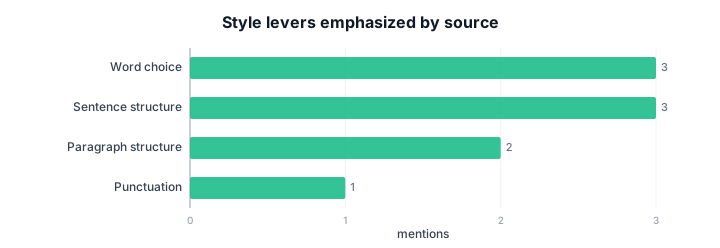
Core style levers — word choice, structure, punctuation — identified across sources.
Sources
- Writing Styles – Graduate Writing and Presenting Lab
- Guidelines for Terse, Factual Engineering Communication
- Writing Styles: What They Are and How to Achieve Yours | Grammarly
- Pandoc - twenty-years-of-pandoc
- Writing style
- GitHub - amperser/proselint: [Mirror] A linter for prose. · GitHub
Generated by tink · sources are web pages; verify anything important.