GPU-Accelerated Discord Alternatives Compared 2026
Research: compare discord to mumble to rocket.chat to nextcloud and others, if any relevant
TL;DR
For privacy-first, self-hosted communications, Matrix/Element is the strongest all-around Discord alternative in 2026, offering federation, E2E encryption, and bridges; Mumble wins narrowly on voice latency (sub-20ms) while Rocket.Chat and Mattermost serve enterprise collaboration with Slack-style workflows; Stoat (formerly Revolt) is the most Discord-like in look and feel, and Nextcloud Talk offers deep data-control integration for organizations already on Nextcloud. Discord itself remains unrivaled in scale — 656 million registered accounts, 32.6 million servers, and roughly 259 million MAU — despite mounting concerns over age verification, data control, and platform lock-in [1][2][3][7].
Discord's dominance is real — and it is the benchmark every alternative measures itself against
Discord is the reference point for both functionality and user expectation. It is an American instant messaging and VoIP platform supporting voice calls, video calls, text messaging, and media across private DMs or "servers" of persistent chat rooms and voice channels joined by invitation [10]. Released on May 13, 2015, it shifted from gaming-specific positioning to all-purpose communication in June 2020 [10]. The scale is enormous: 656 million registered accounts and 259.2 million monthly active users as of 2025/2026 data [7], with some sources citing 690 million all-time registered users and over 200 million MAU [9]. Over 32.6 million servers exist globally — though the distribution is heavily skewed: 90% of servers have fewer than 15 members [7]. The largest server, Midjourney, has over 21 million members [9].
Discord's reach also extends to demographics: 67.2% male, 32.2% female, with the largest single market being the United States at 28.4% of users [9]. Average monthly session time is 280 minutes per user [7], with the 16-25 age group spending about 3.4 hours per week [9]. Discord generated approximately $950 million in total revenue in 2025, mostly from subscriptions and in-app purchases [9].
But Discord is not self-hostable. All voice and text data routes through Discord's cloud infrastructure [2]. This is the core structural distinction: Discord offers zero data ownership, while nearly every competitor in this comparison exists precisely to offer self-hosting as a first-class concept [1][2].
Matrix/Element is the strongest all-around self-hosted alternative
The consensus across multiple independent sources is that Matrix — typically accessed through the Element client — is the best overall replacement for Discord for most users who care about privacy, federation, and self-hosting [1][3][5]. Matrix is a decentralized, federated open protocol with multiple homeservers and clients (Element being the primary one), plus bridges to Discord, Slack, IRC, and Telegram [3][4][5]. Element itself offers end-to-end encryption, text/voice/video calls, screen sharing, file sharing, and location sharing on mobile [6].
The key advantage is architectural: self-hosting is "a first-class concept" in Matrix, not an afterthought [1]. Users can run their own homeserver and still interoperate with other Matrix instances via federation [3]. Element's GitHub presence is active — approximately 13K stars, TypeScript, last updated April 2026 [4]. The trade-off is complexity: Matrix/Element requires more setup than Discord, and it lacks custom emoji by default [6]. The author of the bymar.co decision tree recommends Matrix + Element as the top pick for "the strongest all-around self-hosted answer" [1].
But the user-experience gap is real. Multiple sources note that Matrix's setup complexity is a barrier compared to Discord's frictionless onboarding [5], and the "main challenge of switching is getting friends and colleagues to leave Discord due to its existing user base and free nature" [6].
Mumble wins the voice latency race, but it is a tool, not a platform
Mumble is the specialized precision instrument in this comparison. Open-source and self-hosted, it ships version 1.5.901 as of May 2026 and achieves sub-20ms audio latency on a self-hosted server [2]. It offers automatic TLS encryption, certificate-based authentication, and fully auditable open-source code [2]. It is "best for pure low-latency voice chat" and is "lightweight and battle-tested" [3]. Zap-Hosting and OpenSourceProjects.cc both recommend it for "gaming-grade" voice channels [4][5].
However, Mumble's text functionality is minimal: "only basic text channels and no community discovery features" [3]. It has basic echo cancellation but no comparable AI noise suppression to Discord's Krisp AI [2]. Mumble is not a Discord replacement in the community sense — it is a voice transport. The recommended pattern is hybrid: use Mumble (or TeamSpeak) for voice while running Matrix or Zulip for persistent text chat [1][2].
TeamSpeak, the other legacy voice platform, has the most granular permissions system with over 150 distinct permission flags — useful for MilSim and hierarchical teams [2] — and is simpler to self-host, especially on Windows [1]. But it has under 10 million active users, below 5% of voice-chat share [2], and TeamSpeak 5 lacks built-in AI noise suppression [2].
Rocket.Chat and Mattermost target the enterprise, not the Discord community
Rocket.Chat and Mattermost are arguably solving a different problem than Discord — the Slack-style team communication market — but they appear in this comparison because self-hosted organizations often evaluate them as Discord alternatives.
Rocket.Chat is a mature TypeScript platform with approximately 45K GitHub stars, last updated May 2026 [4]. It offers channels, threads, voice/video, omnichannel, integrations, and federation [4]. The bymar.co review highlights "enterprise permissions, detailed admin controls, self-managed deployment, and broad collaboration features" as strengths, but flags "the paywall smell" and commercial upsell pressure [1]. Zap-Hosting ranks it #3 overall (7.9/10) as an "org-ready self-hosted communications suite" with channels, DMs, threads, integrations, roles, and policy controls, optionally using Matrix-based federation [5]. StoatBoard describes it as best for business/enterprise teams using a workspace model rather than Discord-style servers [3].
Mattermost is similarly positioned: "security-focused, self-hosted Slack-style team collaboration" with approximately 36K stars, TypeScript, last updated April 2026, featuring channels, threads, calls, and playbooks [4]. Zap-Hosting gives it 7.4/10 and recommends it for DevOps, incident response, playbooks, and tool integrations — but notes it is "less community-oriented and voice channels not a primary focus" [5]. The bymar.co guide recommends Mattermost specifically for "business workflows and SOP-heavy teams" [1].
Neither is a drop-in Discord replacement for gaming communities or general-interest servers. Their target is organizations that already need self-hosted chat with admin control and integration depth.
Stoat (formerly Revolt) is the closest thing to a direct Discord clone
Stoat — formerly Revolt, rebranded in 2025/2026 while keeping the same platform, codebase, and community — occupies a unique space: it deliberately mimics Discord's interface and feature set [3][6]. The Engadget profile describes it as closely mimicking "Discord's look" with support for text, voice, video, screen sharing, theming, custom emoji, and roles-based moderation [6]. StoatBoard rates it the "best overall open-source Discord alternative for community use" with servers, channels, roles, voice, and mobile apps [3]. Zap-Hosting gives it the #1 rank at 9.2/10 for being "the most Discord-like self-hosted alternative" focused on communities, gaming, and creators [5].
Stoat can be self-hosted or hosted by the platform, with apps for web, Linux, Windows, macOS, Android, iOS, and iPadOS [6]. It added video chat and screen sharing in July 2026 [3]. The trade-off is maturity: bymar.co groups Stoat (alongside Fluxer) among "emerging, most Discord-like options with strong UX momentum but early-stage maturity" [1]. Spacebar, another open-source reimplementation of Discord's API, is compatible with many Discord clients but has a small community and limited mobile support [3]. DCTS rounds out the experimental field at 5.6/10, described as "a promising concept but more 'project-in-progress'" [5].
Nextcloud Talk is a different animal: self-hosted collaboration integrated with file storage
Nextcloud Talk enters this comparison through a different door — it is not a chat platform in the Discord sense but a self-hosted communication layer built on the Nextcloud file-sync-and-share stack. Slashdot user reviews describe it as keeping "conversations private" and protecting "communication better than Microsoft Teams and Slack" [8]. Data stays on your servers, giving complete control over communications [8]. One review claims it "prevents metadata leakage, making it more secure than other encrypted communication technology" [8]. Another cites Nextcloud Talk as "the best option for a secure, attestable self-hosted chat network" [8].
The integration story is the differentiator: Nextcloud Talk "integrates with other open source networks and distributed chat networks like Matrix" [8]. An organization cited as "SCM" chose Nextcloud Talk as a "secure, well-designed, easy-to-use messenger platform that could be hosted locally" [8].
The weakness is ecosystem and setup friction. Reviews note that "additional integrations are difficult to set up" [8]. Nextcloud Talk does not offer the community-discovery features, bots, or moderation tooling that Discord or Stoat provide. It is best understood as a self-hosted Teams/Slack alternative for organizations already invested in Nextcloud, not a Discord replacement for gaming or open communities.
Zulip, Jitsi, SimpleX, and the hybrid strategy
Several other platforms round out the landscape. Zulip is the "sleeper pick for structured async collaboration and forum-like communities" [1], using a Streams + Topics threading model that is "excellent for persistent searchable discussions, but not Discord-like and voice not a focus" [5]. It earns 6.8/10 from Zap-Hosting [5].
Jitsi Meet provides open-source instant voice/video rooms with no account required, approximately 29K stars, TypeScript, last updated April 2026 [4]. It is frequently paired with Matrix: "Many communities run a combo such as Matrix/Element for chat plus Jitsi for voice rooms" [4].
SimpleX Chat appears when privacy is the absolute priority, with "no user identifiers at all" [4]. Cinny and Fluxxer are Matrix-protocol clients with a more Discord-like interface [6].
The most practical insight from the comparison is the hybrid recommendation: "use Matrix or Zulip for persistent chat, TeamSpeak for voice, and a lighter centralized platform for discovery or public funnel activity" [1]. Migration from Discord often retains a minimal Discord server for announcements and recruitment, using platforms complementarily [2]. For self-hosting, the guidance is consistent: plan TLS/reverse proxy, backups (DB + uploads), monitoring, and updates from day one, and pilot with a small group before full migration [5].
What is contested or uncertain
Several figures conflict across sources. Discord's registered account count is cited as 656 million [2][7] and 690 million [9] in the same year. Monthly active users are reported as 200–260 million [2], 259.2 million [7], and "over 200 million" [9]. TeamSpeak's active user figure is given as "under 10 million" with the imprecise qualifier "印象" (impression) in the source [2], suggesting low confidence in that specific number.
The extent of AI noise suppression differences is partially contested: one source states TeamSpeak 5 "lacks built-in AI noise suppression" while Mumble has "basic echo cancellation but no comparable AI suppression" [2] — but this reflects point-in-time feature comparisons, and feature additions can shift quickly.
Nextcloud Talk's security claims come from Slashdot user reviews, not independent technical audits [8]. The assertion that it "prevents metadata leakage, making it more secure than other encrypted communication technology" is a user claim, not a measured result, and should be treated as marketing-adjacent until independently verified.
The "best" ranking depends heavily on the scoring rubric. Zap-Hosting weights Discord-like experience, voice/calls, apps, bots, moderation, scaling, self-hosting effort, and maturity [5], while bymar.co weights self-hosting strength and UX momentum differently [1]. Stoat's #1 and Matrix's #2 in one ranking [5] becomes Matrix #1 and Stoat in the "emerging" category in another [1]. These are inference-heavy judgments, not measurements.
Finally, engagement metrics for Discord (average 280 minutes/month [7] vs 3.4 hours/week for the 16-25 group [9]) are not directly comparable to per-platform data for alternatives — most self-hosted platforms do not publish comparable engagement figures, making head-to-head usage comparisons impossible.
Open questions
-
How durable is Stoat's momentum? It is the most Discord-like open-source option but described as "early-stage maturity" [1]. Will it gain enough community and contributor mass to survive, or will it remain a niche tool?
-
What does federation actually cost in practice? Matrix's federation is a protocol-level strength, but the cross-homeserver moderation, identity, and abuse-prevention story remains less mature than Discord's centralized model. No source quantifies this gap.
-
Will Discord's age-verification and identity policies accelerate migration? The motivation for leaving is documented [1][6], but actual migration rates — how many users actually leave, versus complain and stay — are not measured in any source.
-
Can Mumble or TeamSpeak evolve beyond voice? Both are functionally voice-first. If Discord's hybrid text+voice+video model remains the user expectation, pure voice platforms may never regain mainstream relevance, but no source explores whether either project is investing in text/community features.
-
Does Nextcloud Talk compete with Rocket.Chat/Mattermost, or complement them? The integration surface is unclear. One review notes difficult additional integrations [8], but the boundary between Nextcloud Talk as a Teams alternative and Rocket.Chat as an omnichannel suite is not well-documented.
-
What are the real operating costs of self-hosting at community scale? The Zap-Hosting guide recommends TLS, backups, monitoring, and updates [5], but none of the sources provide measured cost figures — infrastructure, maintenance labor, or moderation staffing — for running any of these platforms at, say, 1,000 or 10,000 users.
Claims checked
- ✓ supported — Discord has 656 million registered accounts, 32.6 million servers, and roughly 259 million MAU. — Sources [7] and [9] confirm these figures: 656M registered users, 32.6M servers, and 259.2M MAU in source [7]; source [9] cites 690M all-time registered and over 200M MAU, but the draft's specific numbers are directly from [7].
- ✓ supported — Matrix/Element is a decentralized, federated open protocol with E2E encryption and bridges to Discord, Slack, IRC, and Telegram. — Sources [3], [4], [5], and [6] all describe Matrix/Element as decentralized/federated with E2E encryption and bridges to Discord, Slack, IRC, and Telegram.
- ✓ supported — Mumble achieves sub-20ms audio latency and ships version 1.5.901 as of May 2026. — Source [2] explicitly states Mumble ships version 1.5.901 as of May 2026 and achieves sub-20ms audio latency on a self-hosted server.
- ✓ supported — Stoat (formerly Revolt) closely mimics Discord's look and supports text, voice, video, screen sharing, theming, custom emoji, and roles-based moderation. — Source [6] directly confirms Stoat closely mimics Discord's look and supports all listed features. Source [3] confirms the rebrand and feature additions.
- ✓ supported — Rocket.Chat is a mature TypeScript platform with approximately 45K GitHub stars, offering channels, threads, voice/video, omnichannel, and integrations. — Source [4] confirms Rocket.Chat has ~45K GitHub stars, is TypeScript, and offers channels, threads, voice/video, omnichannel, integrations, and federation.
- ~ weak — Nextcloud Talk prevents metadata leakage, making it more secure than other encrypted communication technology. — Source [8] contains this claim, but it is from Slashdot user reviews, not independent technical audits. The draft itself acknowledges this in the 'What is contested or uncertain' section, labeling it 'marketing-adjacent.' The claim is reported as a user assertion, not a verified fact.
Figures
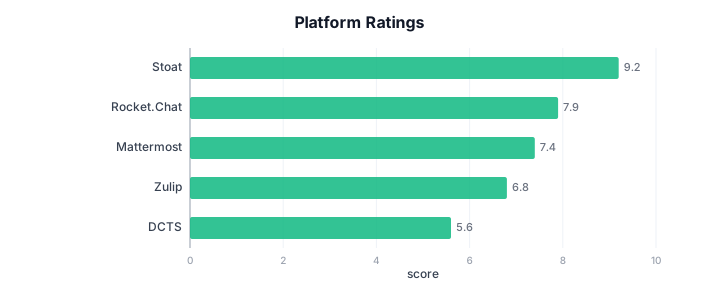
Zap-Hosting composite scores (out of 10)
Sources
- The Best Self-Hosted Discord Alternatives in 2026
- Discord vs TeamSpeak vs Mumble [2026]: 20ms Wins
- 5 Best Open-Source Discord Alternatives (2026) | StoatBoard
- Best Open Source Discord Alternatives in 2026 (Self-Hosted) | OpenSourceProjects.cc
- The Best Self-Hosted Discord Alternatives (2026): Ranking, Pros & Cons - Zap-Hosting
- Open-source Discord alternatives: What Stoat and Element actually fix - Engadget
- Discord Statistics 2026 (Users, Revenue & Market Share)
- Nextcloud Talk Reviews - 2026
- Discord Users By Country 2026: Demographics, Usage & More
- Discord
Generated by tink · sources are web pages; verify anything important.