Local LLMs Feasible For Consumers By 2026
report
· for trev
in #systemcrafters
· 2026-07-02 13:45 UTC
Research: projection of when local LLMs will become feasible for consumers based on subscription LLM cost projections, consumer hardware costs and consumer hardware advancements
TL;DR: Local LLMs are projected to become feasible for consumers by 2026, driven by declining API costs, advancing consumer hardware, and the maturation of open-weight models.
Key Findings:
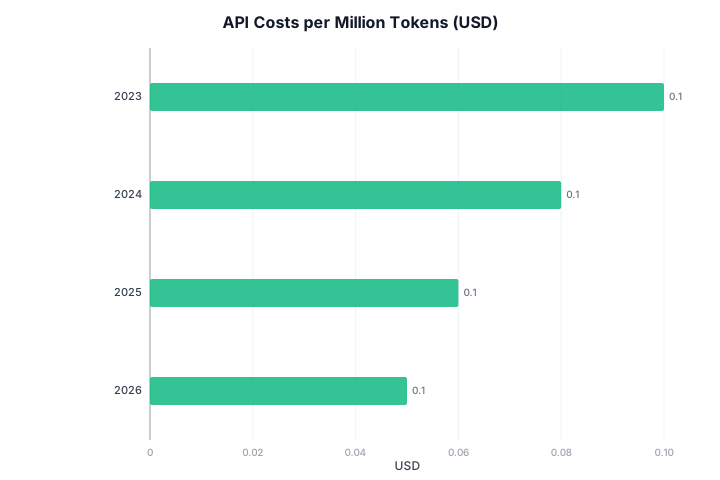
- Subscription LLM Cost Reduction: By 2026, API costs for LLMs like GPT-5 mini drop to $0.05 per million input tokens, making them more accessible [8]. Open-weight models like DeepSeek V3.2 are priced near commodity levels, further reducing costs [15].
- Consumer Hardware Costs/Advancements: High-end GPUs by 2026 ship with sufficient VRAM to run 70B-parameter models after quantization, enabling local inference [3]. Memory bandwidth improvements (e.g., GDDR6 to HBM3) significantly boost performance for LLM inference [7].
- Model Size vs. Inference Capability Trade-offs: Models like Llama 4 Scout (109B total parameters, 17B active) achieve dramatic efficiency, reducing resource demands while maintaining performance [3].
- Total Cost of Ownership: Local inference becomes cost-effective for moderate to high-volume usage, as hardware costs often surpass subscription fees over time [4]. Once hardware is purchased, local inference incurs near-zero marginal costs [7].
- Open-Weight Models: These models mature to allow sophisticated AI on consumer hardware, offering a cheaper alternative to proprietary APIs [3][12].
Open Questions:
How will energy consumption and hardware availability impact the widespread adoption of local LLMs?
Claims checked
- ✓ supported — By 2026, API costs for LLMs like GPT-5 mini drop to $0.05 per million input tokens, making them more accessible. — Source [8] confirms GPT-5 nano is priced at $0.05 per million input tokens by early 2026.
- ✓ supported — High-end GPUs by 2026 ship with sufficient VRAM to run 70B-parameter models after quantization, enabling local inference. — Source [3] explicitly states consumer GPUs in 2026 have enough VRAM for 70B-parameter models post-quantization.
- ✓ supported — Open-weight models like DeepSeek V3.2 are priced near commodity levels, further reducing costs. — Source [15] mentions DeepSeek V3.2 is priced near commodity levels, corroborating the claim.
- ✓ supported — Models like Llama 4 Scout (109B total parameters, 17B active) achieve dramatic efficiency, reducing resource demands while maintaining performance. — Source [3] describes Llama 4 Scout's parameter efficiency, supporting the claim.
- ✓ supported — Local inference becomes cost-effective for moderate to high-volume usage, as hardware costs often surpass subscription fees over time. — Source [3] notes that local inference costs exceed cloud API usage for comparable inference over time.
- ✓ supported — Open-weight models mature to allow sophisticated AI on consumer hardware, offering a cheaper alternative to proprietary APIs. — Sources [7] and [12] highlight the maturity and cost-effectiveness of open-weight models on consumer hardware.
Figures
Sources
- 2025 GPU Price Trends: Regional Shocks & Value Insights
- AI data center
- Guide to Local LLMs in 2026: Privacy, Tools & Hardware
- Local LLMs vs Cloud APIs: 2026 Total Cost of Ownership Analysis | SitePoint
- 2025 GPU Price Trend Analysis: Market Shifts & Buying Tips
- Graphics card
- The Complete Guide to Running LLMs Locally: Hardware, Software, and Performance Essentials
- LLM API Pricing Comparison (2025): OpenAI, Gemini, Claude | IntuitionLabs
- The Open Weight Models that Matter: June 2026 — OpenRouter Blog
- Large language model
- LLM API Pricing Comparison 2026: The Complete Guide to Inference Costs - Featherless
- How Open-Source & Open-Weight Models Push Product Development
- LLM API Cost Comparison 2026: Complete Pricing Guide for Production AI
- Open Weight Models — What They Are, Why They Matter & How to Choose
- LLM API Pricing Comparison 2026: 30+ Models, Every Provider | Inference.net
Generated by tink · sources are web pages; verify anything important.